> For the complete documentation index, see [llms.txt](https://help.wotnot.io/llms.txt). Markdown versions of documentation pages are available by appending `.md` to page URLs; this page is available as [Markdown](https://help.wotnot.io/monitor/reporting/dril-in-into-metrics.md).
# Dril-in into metrics
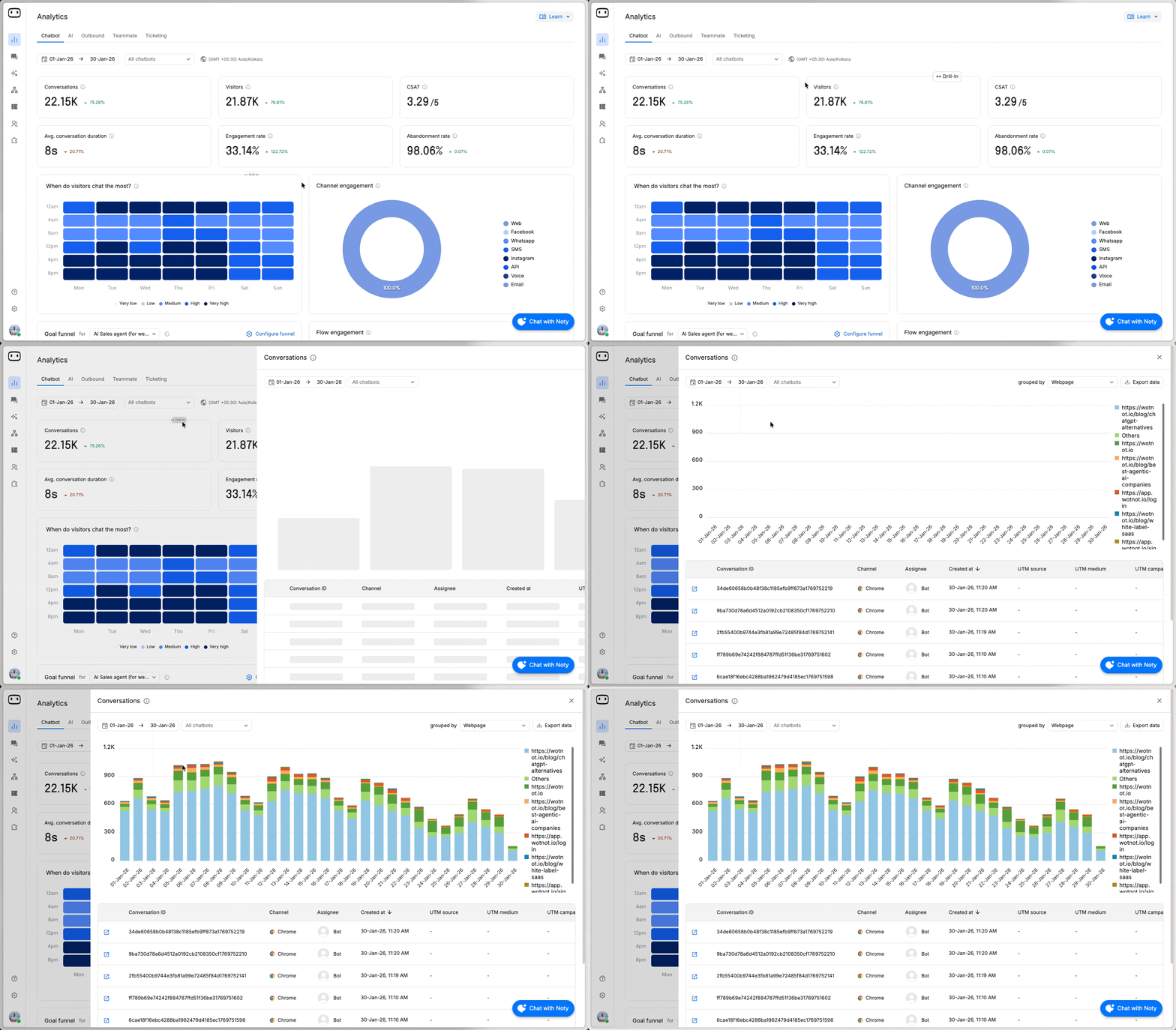
The Drill In feature lets you go beyond high-level KPIs and understand the raw data behind every metric on your reporting dashboard.
### What is Drill In?
When you click Drill In on any KPI card (for example, *Conversations*, *Leads*, or *Chat Started*), you’re taken to a detailed view that breaks down how that metric was calculated.
This view combines insightful charts with row-level data, so you can analyze trends and individual records in one place.
### What you can do in Drill In
Once you drill in, you can:
* **View detailed charts**
See how the metric trends over time or across dimensions like webpage, chatbot, or date.
* **Access raw data**
Explore the exact conversations or events that make up the KPI.
* **Apply filters**
Narrow down data by date range, chatbot, webpage, channel, or other available filters.
* **Export to CSV**
Download the filtered data as a CSV file for further analysis or reporting.
### Why use Drill In?
* Validate KPI numbers with underlying data
* Identify trends, spikes, or drop-offs quickly
* Share detailed reports with stakeholders
* Perform deeper analysis outside the platform using exported data
### Example use cases
* Understand which webpages contribute most to conversations
* Analyze daily fluctuations in chatbot usage
* Audit individual conversations behind a KPI drop or spike
---
# Agent Instructions
This documentation is published with GitBook. GitBook is the documentation platform designed so that both humans and AI agents can read, navigate, and reason over technical content effectively. Learn more at gitbook.com.
## Querying This Documentation
If you need additional information that is not directly available in this page, you can query the documentation dynamically by asking a question.
Perform an HTTP GET request on the current page URL with the `ask` query parameter, and the optional `goal` query parameter:
```
GET https://help.wotnot.io/monitor/reporting/dril-in-into-metrics.md?ask=&goal=
```
`ask` is the immediate question: it should be specific, self-contained, and written in natural language.
`goal` is optional and describes the broader end goal you are ultimately trying to accomplish on behalf of the user. GitBook uses it to tailor the answer towards what is most useful for that goal.
The response will contain a direct answer to the question and relevant excerpts and sources from the documentation.
Use this mechanism when the answer is not explicitly present in the current page, you need clarification or additional context, or you want to retrieve related documentation sections.